


 RSS Feed
 Email
 Twitter
 Facebook
Unlocking solar market
 Twitter
 Facebook
 Delicious
 Digg
 Stumble
 Reddit
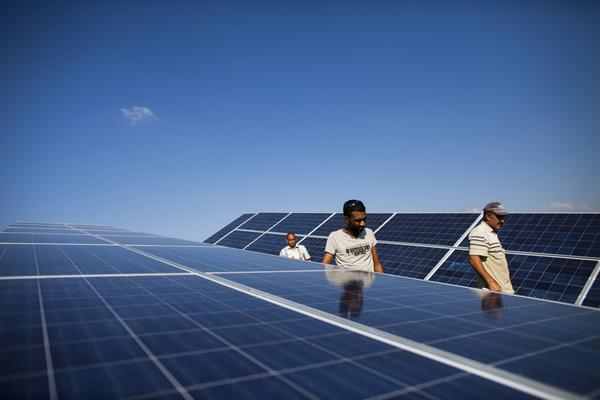 WHILE the solar power potential in Pakistan stands at 2.9m megawatts, only 100 megawatts of grid-tied solar power have been commissioned to date.
Wind power proposals have seen an upsurge since 2012 with at least 477 megawatts projects reaching financial closure to date, demonstrating a viable market for renewable energy. Last month, Nepra announced a new round of solar tariffs valid until June 30, 2016.
Eyeing the business potential, the International Finance Corporation has released a guide for investors to develop renewable energy particularly solar projects in the country.
The IFC handbook ‘A Solar Developer’s Guide to Pakistan’ provides vital information for international investors and developers implementing solar projects, outlining development procedures and explaining the legal and regulatory mechanisms around them. It also explains the requirements surrounding the preparation, agreement, approval and implementation of projects up to financial close.
Eyeing the business potential, the International Finance Corporation has released a guide for investors to develop renewable energy, particularly, solar projects in Pakistan
The country’s first step towards firm support of renewables in its energy mix came in 2006 when it announced ‘Development of Renewable Energy Generation Policy’ which dealt with wind, solar and small hydro projects up to 50MW.
While initial progress has been slow, investors’ interest has gained momentum over the last five years particularly in the wind and hydro sector and more recently in solar. To date, however, the only grid connected (100MW) project is the one commissioned by the Punjab government in May 2015.
The Alternative Energy Development Board (AEDB) reports that 35 projects with a capacity of 1,111.4MW are under development within the board’s framework. Upfront tariffs have been approved for 10 developers and of those three projects of 100MW each have signed a power purchase agreement.
The IFC guide also spells out challenges and recommendations, identifying major issues with the input of various developers, tariff determination and industry norms.
Referring to timeline and policy uncertainty, the guide points out that no privately financed solar IPP has reached financial close in Pakistan. It is understood that projects awarded tariffs under the 2014 and 2015 determinations have been stalled as the Central Power Purchase Agency (CPPA) has been waiting for a lower tariff.
This has impacted investor confidence. Nepra is clear that the CPPA must honour those tariffs and has been consistent in granting timeline extensions to developers for reaching financial close, where the government organisations have not been cooperative. In addition, the issuance of letters of intent (LoIs) by the AEDB and provincial agencies had stalled in 2015 on the basis that a new tariff was expected. It is hoped that the issue will be resolved after publication of tariffs for 2016.
Land identification is one of the main hurdles for international developers looking to enter the Pakistani market. If a local partner is not found who already has land access, it may take some time to identify lands that are suitable for a solar project.
The lack of access to good digitalised maps makes things more difficult. The AEDB and the Sindh government are trying to make the process more investor-friendly by identifying suitable lands.
Referring to transmission issues, the IFC guide points out a number of applications for solar projects are pending with the National Transmission and Despatch Company (NTDC) which, owing to a regulatory uncertainty, has not been processing them as quickly as timelines require.
Under the 2006 policy, the NTDC is required to provide grid interconnection but this can take time and requires funding. The IFC has recommended that the NTDC be approached by investors as soon as possible. The developers should work with them and local consultants to identify areas that are most suitable for evacuation of power and that do not require substantial construction of transmission lines.
In the distributed solar space, the market has also been developing. With the rising costs of electricity and unreliable grid supply, more industries and commercial organisations are turning to captive solar solutions. There has been a strong surge in domestic installation of rooftop photo voltic panels in big cities. The private sector imported 350MW of solar panels in 2013.
For projects under 1MW, net metering regulations came into effect in September 2015. This sector is expected to see significant growth in the coming years. Pakistan is targeting at least one million customers and adding approximately 3,000MW of solar power through net metering.
Under the 2006 policy, solar power project developers can also enter into direct bilateral sales contracts with end-use customers to sell part of the power generated by them to their direct customers and the rest to the utility company for general distribution.
For direct sales, they are required to pay wheeling charges for the use of the transmission/and or distribution grid network used to transport the power from the plant to the purchaser. Until now, there are no known solar projects that are selling power on a bilateral basis.
Source: Dawn