


 RSS Feed
 Email
 Twitter
 Facebook
Solar Water Pumps Wean Farmers From India’s Archaic Grid
 Twitter
 Facebook
 Delicious
 Digg
 Stumble
 Reddit
By Natalie Obiko Pearson and Ganesh Nagarajan - Feb 7, 2014
India has a novel idea: Wean farmers from archaic power lines and expensive diesel fuel to run their water pumps with solar energy.
The government is looking to swap 26 million groundwater pumps for more efficient irrigation models powered by the sun. If successful, crop production could rise in India, where farms suffer from blackouts and volatile fuel costs. It would also save about $6 billion a year in power and diesel subsidies.
Companies targeting the market include BlackRock Inc (BLK).- backed SunEdison Inc. (SUNE), Asia’s top irrigation-equipment maker Jain Irrigation Systems Ltd. (JI), Claro Energy Pvt., whose investors include Standard Chartered Plc Managing Director Arun Singhal, and the solar unit of the Tata group, India’s biggest conglomerate.
“The potential is huge,” Tarun Kapoor, joint secretary at India’s Ministry of New and Renewable Energy, said in an interview. “Irrigation pumps may be the single largest application for solar in the country.”
Asia’s second-most populous nation will draw 100 billion rupees ($1.6 billion) of investment in the next five years as the first 200,000 most easily replaceable pumps are switched to solar, the government estimates. That will relieve an overburdened power-transmission grid built mostly in the 1960s that’s prone to failures.
A risk in converting to solar pumps is that farmers may use excessive amounts of water because the devices have almost no operating costs. To avoid that, farmers must use water-saving drip irrigation in exchange for accepting subsidies to buy solar water pumps.
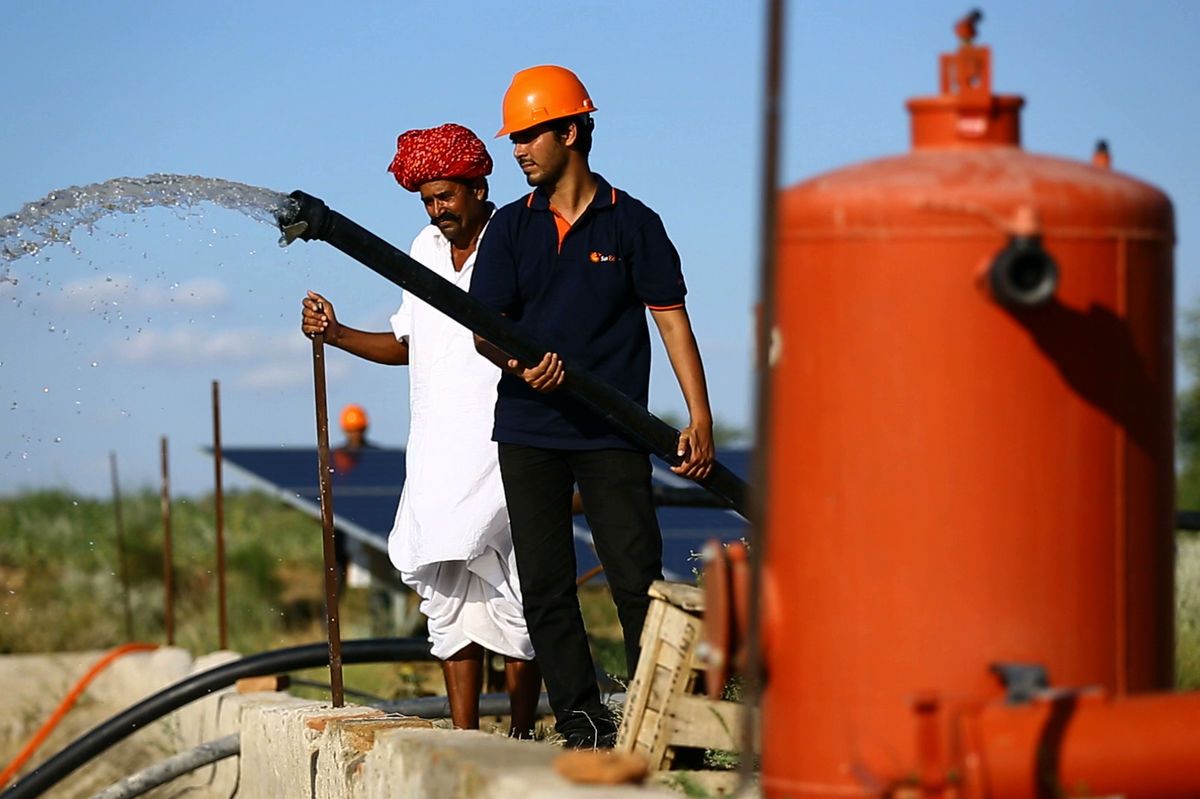
One who has already seen the benefits of switching over is O.V.R. Somasundaram, a 67-year-old who grows coconuts, nutmeg and cocoa in southern India. He invested two years ago in a solar pump from St. Peters, Missouri-based SunEdison.
Snake-Bite Risk
Somasundaram’s 75 acres of farmland in Coimbatore, Tamil Nadu, used to be dependent on electricity from the state, sometimes only available four hours a day from an antiquated grid. When the power came on, it was often at night, meaning workers risked snake bites as they wandered into dark fields.
“Crops need water,” he said in an interview in Chennai. “My crops would have failed if I hadn’t opted for a solar pump.”
Somasundaram now gets water when he needs it, throughout the year when the sun is out, and without the fuel costs of a diesel generator. He irrigates a third of his holdings with the system, which cost 400,000 rupees after 60 percent was subsidized.
‘Break Link’
The new water reliability from a technology that moves away from older energy sources will allow him to plant an extra crop, black peppers. About 3,000 saplings are to be sowed by March.
Using fossil fuel-based power to pump well, canal and farm water also contributes to climate change, said Aaron Mandel, founder of WaterFX, which sells solar desalination technology.
Let’s “break the link between carbon-based fuels and additional water production,” Mandel said. “The best way to do this is for the water industry to begin to take advantage of the cost reductions that have already occurred in renewable energy.”
The cost of photovoltaic panels that have slumped by half since 2010 and government subsidies mean the payback period of a solar pump system is one to four years, said Ajay Goel, chief executive officer of Tata Power Solar Systems Ltd., a panel maker and contractor that belongs to the $100 billion Tata group, which has businesses including steel, software services and vehicles.
Eliminate Subsidies
The government funds in some states as much as 86 percent of the cost of solar pump systems that in the long run save money because they eliminate $6 billion in annual farm diesel and electricity subsidies, according to Kapoor. That aid helped nudge India’s current-account deficit to a record last year.
The economics will only get better as diesel prices rise and scale brings more efficiencies, eliminating the need for state support, said Stephan Grinzinger, head of sales for Lorentz Vertriebs GmbH, a German maker of solar water pumps.
“Because of the drop in photovoltaic prices, globally we’re selling more solar pumps without subsidies than with,” Grinzinger said. Lorentz operates in 130 countries, he said.
The change comes as production of mainstay crops like wheat, corn and rice stagnate in India, according to a 2012 study of nearly five decades of yield data published by the journal Nature Communications. The reasons included water scarcity and falling groundwater tables.
Farmers needing cash for diesel will often promise their harvest upfront to pay for the fuel, agreeing to low prices for their crops. As water demand rises during the growing season, diesel prices spike on the black market.
Largest Blackout
In 2012, farmers forced to run electric pumps after a bad monsoon contributed to the world’s biggest blackout that left almost 360 million people in the dark for days, according to the World Resources Institute.
About 8 million diesel pumps already in use could be replaced economically now, said Pashupathy Gopalan, SunEdison’s regional head. The ministry’s Kapoor estimates another 700,000 diesel pumps are bought every year in India that could be displaced with solar.
“It’s a phenomenally strong growth market for solar energy,” said Gopalan of SunEdison, the world’s second-biggest contractor of photovoltaic plants, according to IHS Inc. (IHS) The company introduced a solar water pump in India in November.
Revenue growth from the solar business at Jain Irrigation has outpaced its food and irrigation products by more than double since 2009, according to its annual report. Jain spokesmen didn’t respond to two e-mails and a phone call seeking comment. Jain climbed as much as 2.5 percent to a two-week high today and closed up 0.8 percent to 63.50 rupees in Mumbai. The benchmark S&P BSE Sensex advanced 0.3 percent.
Funding Growth
Claro Energy plans to raise additional funding this year as it quadruples installations to more than 1,300 pumps, Director Soumitra Mishra said by e-mail.
Solar pumping may have far-reaching impacts on agriculture in India, where monsoon rains dictate sowing cycles of crops such as rice, soybeans and peanuts, said Avinash Kishore, an associate research fellow at the International Food Policy Research Institute in New Delhi.
In the fertile east, solar pumping could reduce floods and boost rice and wheat harvests, said Tushaar Shah, a senior fellow at Colombo, Sri Lanka-based International Water Management Institute.
‘A Godsend’
In water-stressed regions including Rajasthan, home to the biggest state solar-pump program, the project is unique in scale, with larger private farmers looking to exchange grid and diesel systems.
“For a single country, a single program, this is the largest project in the world for solar pumps,” Grinzinger of Lorentz said.
Yet it may also encourage farmers to overdraw water because the cost of running the sun-powered machines is negligible.
“You have to be careful. All sorts of possibilities come up as costs come down,” Shah said. “For water-abundant, especially flood-prone areas of eastern India, solar pumps can be a godsend.”
To contact the reporters on this story: Natalie Obiko Pearson in Mumbai at [email protected]; Ganesh Nagarajan in Chennai at [email protected]
To contact the editors responsible for this story: Randall Hackley at [email protected]; Reed Landberg at [email protected]
Image Source: Bloomberg