


 RSS Feed
 Email
 Twitter
 Facebook
Public procurement in Africa benefitting family farmers and schools
 Twitter
 Facebook
 Delicious
 Digg
 Stumble
 Reddit
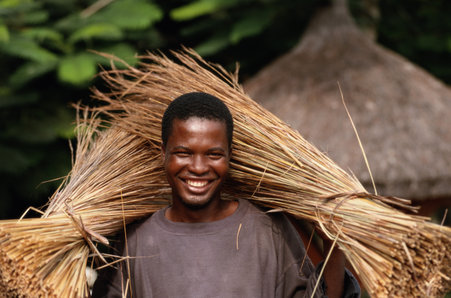 10 March 2015, Rome - An innovative partnership spanning five African countries is providing important lessons on how governments can procure food for public institutions, such as schools, directly from small-scale family farmers. Modelled on Brazil’s achievements in fighting hunger and poverty, the Purchase from Africans for Africa programme (PAA Africa) helps promote local agricultural production while also improving livelihoods and nutrition.
PAA Africa is implemented by Ethiopia, Malawi, Mozambique, Niger and Senegal with technical leadership and expertise from FAO and the World Food Programme (WFP). Now entering its third year, the programme is yielding promising results as detailed in a recently released report.
As the PAA Africa programme shows, in developing countries the purchasing of produce from family-farmers - often among the most marginalized groups - can contribute towards government efforts to combat rural poverty. “Public purchasing from local producers adds value to local markets by integrating small-scale family farmers and by channelling demand - in this case from schools - for their produce, contributing to food security and diversity,” said Florence Tartanac, of FAO’s rural infrastructure and agro-industries division.
FAO provides technical assistance for governments’ planning and policy aspects, while its experts work with family farmers to help them achieve sustainable gains in agricultural productivity, as well as improve their harvesting and post-harvest techniques - including the construction of silos - leading to better quality produce and less loss and waste. Financial support for the work comes from the Brazilian government and the United Kingdom’s Department for International Development (DFID).
Promoting inclusive policies
“Public purchasing from local farmers could promote local diversified production and value chains, ensure that students have regular access to food, and over the longer term increase human capital through higher school attendance and the better learning that results when children are well-fed,” said Tartanac.
For instance, in Niger, the government decided to target family farmers to replenish the national cereal reserve, creating a 10 percent quota for local procurement from small farmers’ organizations. In the same manner, government could target local family farmers to supply part of the food demand of other public institutions such as schools and hospitals.
Noteworthy results
The around 5,500 small-scale family farmers who have participated in the PAA Africa programme so far have been able to boost their productivity by 115 percent. This was largely thanks to better access to agricultural inputs, including seeds and fertilizers, and to the use of new farming techniques acquired in PAA Africa trainings, such a combining legume and cereal crops in the same plots.
Despite being responsible for producing 80 per cent of Sub-Saharan Africa’s food supply, small-scale farmers - particularly women - often struggle with the inefficiencies of local food systems and lack of inclusive market access. The programme was able to guarantee markets for an average of 37 percent of the food produced, helping farmers generate income over and above their own food requirements.
Part of the farmers’ improved output is used to supply high quality food for use in school feeding programmes. During the programme’s first two years, some 1,000 tons of locally procured food was used to regularly provide school meals for around 128 000 students in 420 different schools. And through PAA Africa, WFP’s Purchase for Progress (P4P) has been able to test diverse models of direct procurement from family farmers’ organizations.
Combining social protection and agriculture
As with the Brazilian Zero Hunger initiative which inspired it, the PAA Africa programme shows how integrating agricultural interventions with social transfers (social safety nets) for poverty reduction can help promote the productive inclusion into the market of subsistence farmers who already have some social and agricultural potential.
For PAA Africa this kind of integration can also increase the impact of local food purchases on participants’ livelihoods and help build sustainable rural development models, by coherently combining agricultural interventions, local food purchases and social protection. In Senegal, for example, the programme targeted the most vulnerable in a food deficit region - farmers hard-hit by recent droughts. These farmers received not only inputs such as rice seeds and trainings, but also found through PAA Africa a predictable and guaranteed market for a share of their production.
PAA Africa is also an example of South-South cooperation, an approach to development built on the sharing of knowledge, experiences and technology among countries in the global South. FAO is exploring multiple approaches of institutional procurement programmes through a series of case studies, including “The Case of Brazil”.
-FAO