


 RSS Feed
 Email
 Twitter
 Facebook
Phone apps among new tech tools for cotton farmers
 Twitter
 Facebook
 Delicious
 Digg
 Stumble
 Reddit
By MELISSA ST. AUDE, Staff Writer
Gone are the days when cotton growers had to stand in a cotton field and take measurements, then consult spreadsheets and paper bulletins to determine if plant growth was on track, lagging or moving too fast.
Mobile Cotton changes that by putting a wealth of University of Arizona research only a few fingertip taps away for any grower with a smartphone or tablet.
Using the new mobile application, released in April, growers input a few parameters into their device, then receive real-time information about their crop’s growth. Is more fertilizer needed? Should fertilizer applications be cut back?
And the information is accessible from anywhere — the middle of a cotton field, the comfort of a living room or hundreds of miles away.
“As long as they can access the Internet, they can use the app,” said Pedro Andrade-Sanchez, professor of precision agriculture with the University of Arizona.
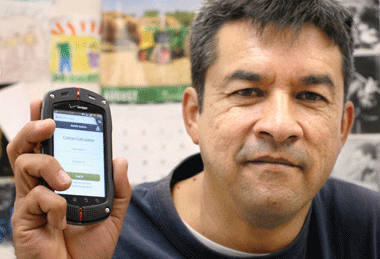
The new app is one of a growing number of technologies aimed at taking much of the guess work and inefficiency out of agriculture by delivering necessary information quickly to farmers.
“It puts accurate, up-to-date information in the hands of growers, helping them make better decisions,” Andrade-Sanchez said. “Cotton is different from a lot of other plants. Its growth has to be managed.”
Andrade-Sanchez said more growers are embracing technology and carrying smartphones or tablets, creating a need for apps such as Mobile Cotton.
“Five years ago technology was very different than it is today,” he said. “And five years from now, it will be even more different. In the future, these tools will be improved or made better.”
Mobile Cotton combines good-quality research with the flexibility of a mobile device, he said.
“There’s excitement, but it does take time to adopt new technology,” Andrade-Sanchez said.
Although it has only been on the market for a few months, by early September, about 10 accounts had been created for Mobile Cotton. Andrade-Sanchez said each account could have hundreds of acres or multiple farmers associated with it.
Developing Mobile Cotton was a collaboration between Andrade-Sanchez and fellow researchers Randy Norton, Jeff Silvertooth and Paul Brown.
Another app for mobile devices is also available for growers. Differentiating Diseases of Early Season Cotton was developed by Mary Olsen, plant pathology specialist in the UA School of Plant Sciences, Andrade-Sanchez said.
That program offers growers information about various cotton diseases and suggestions for treating them.
Both programs, he said, are aimed at making information more accessible and user-friendly.
“Mobile Cotton is very easy to use,” he said. “It’s a great tool. Growers can make decisions based on the data it provides.”
As a precision agriculture researcher, Andrade-Sanchez strives to find ways to integrate technology with farming so that growers can be more efficient.
The researchers also are writing algorithms for sensors, including one, which when attached to a GPS/auto-steer system, determines where fertilizer needs to be applied by detecting the nutrients in the soil.
“The computer knows the position of the tractor. It knows it is pulling a sprayer of liquid fertilizer. It knows the geometry of the sprayer and the rate of delivery that the fertilizer is being applied and because of the integration with the GPS system, it knows if fertilizer has already been applied to that spot, so it will automatically shut off if going over the same area twice,” Andrade-Sanchez said.
Although similar systems are in use in other farming regions, none is adjusted for Arizona soil.
“That is what we are working on here,” Andrade-Sanchez said. “Algorithms are different for every region. That’s why it’s critical that we develop our own.”
Usually, fertilizer is applied uniformly, but the right sensor can determine various field variabilities and apply fertilizer as necessary for targeted areas, saving a grower from unnecessarily applying too much fertilizer, Andrade-Sanchez said.
The sensor is being developed with soil chemist Charles Sanchez.
“The sensors would tailor the rates of application to better fit the needs of the soil and provide site-specific management,” Andrade-Sanchez said.
The sensor is a work in progress, he added.
To help growers better understand evolving farm technology and tools, UA’s Maricopa Agricultural Center routinely hosts open houses, workshops and one-on-one meetings with growers to educate them and answer their questions about commercially available systems.
Give it a try
To learn more about precision agriculture and how new phone apps can assist growers, call Pedro Andrade-Sanchez at Maricopa Agricultural Center, 520-381-2278.
Source:trivalleycentral.com