


 RSS Feed
 Email
 Twitter
 Facebook
Onion Production Through Sets During Autumn Season
 Twitter
 Facebook
 Delicious
 Digg
 Stumble
 Reddit
Dr. Khalid Mahmood Khokhar
Onion (Allium cepa L) is one of the important condiments widely used in all households through the year. Onions may be eaten raw, fried and pickled. The green leaves and immature and mature bulbs are eaten raw or used in preparation of vegetables. Onions are used in soups, sauces and for seasoning foods. The small bulbs are pickled in vinegar. Recent research has suggested that onions in the diet may play a part in preventing heat stroke and other ailments. Onion bulb is rich in phosphorus, calcium and carbohydrates. The pungency in onion is due to a volatile oil known as allyl-propyl disulphide.
The major onion growing districts of Pakistan are Kasur and Vehari, in Punjab; Hyderabad, Sanghar, Mirpurkhas, Nawabshah, Dadu , Badin, N. Feroze, Ghotki and Shikarpur in Sindh; Swat and Dir in KPK and Chaghi, Kharan, Kalat, Nasirabad, Mastung, Killa Saifullah, Khuzdar, Turbat and Jaffarabad in Balochistan. These 22 districts account for more than 77 percent of the total production of onion in Pakistan. More than 50 percent of the total production comes from eight districts namely Hyderabad, Sanghar, Mirpurkhas, Nawabshah, Swat, Chaghi, Kharan and Kalat. Top ten onion producing districts are Chaghi, Hyderabad, Sanghar, Swat, Kharan, Kalat, Mirpurkhas, Nawabshah, Nasirabad and Dir contributing more than 59% of total production.
Temperature and Photoperiod
Onion is a cool season plant, its optimum temperature for seed germination ranges from 20-25 °C, early growth stages before bulbing require 13 to 20 °C and bulb development needs 16 to 25 °C. At low temperature, bulbing takes place very slowly and if the temperature is very low, no bulbing takes place. At low temperature onions are more inclined to bolt.
Photoperiod plays critical role on bulb development and also determines the suitability of a cultivar for a particular region. Onion cultivars are classified into short, intermediate and long day types according to the minimum day length needed to stimulate bulb development. Onion varieties adapted to tropics only form bulbs when grown in areas having 10 to 12 hours of day light (short day types onion) but varieties adapted to the sub-tropics require somewhat long day lengths from 13 to 14 hours (intermediate day type onion) to initiate bulb formation. The long day types require above 16 hours for bulb formation and are not suitable in our environmental conditions. Only short to intermediate day length types respond well. Therefore, for successful production of onions it is imperative to select the suitable varieties for each agro-ecological region.
Autumn crop
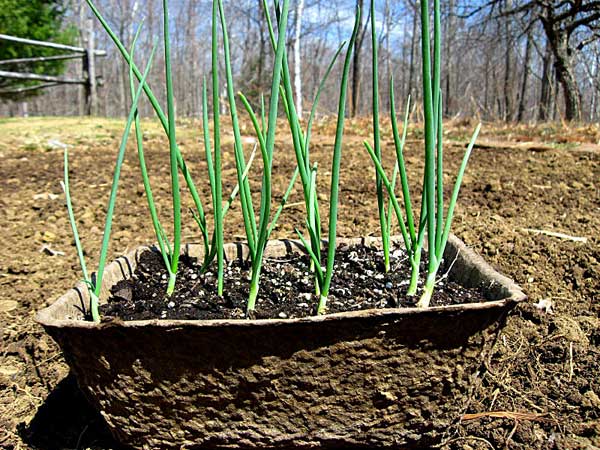
Onion is grown throughout Pakistan in varying volumes and with different harvesting periods. However, supply of onion falls in short of requirements from December-January and prices soar to more than five times compared with normal season. The nursery for autumn crop of onion is raised in first week of July and the seedlings are transplanted in the field in the middle of August for harvesting of bulbs during November/December. It is difficult to manage nursery seedlings of autumn crop because of high temperature and monsoon rains. Sometimes, the heavy rains cause severe damage to nursery seedlings. This difficulty can be overcome through direct planting of onion sets and to eliminate the step of nursery raising which is not only time consuming but laborious as well. All varieties of onion are not suitable for autumn crop. Furthermore, size of onion set is closely related to subsequent bulb yield. During 1999-2005, work on autumn crop of onion production through sets was conducted at NARC. Phulkara variety of onion was found most suitable for autumn season cultivation. Set size in the range of 17-21 mm diameter produced the highest marketable bulb yield of onion.
Onion sets- alternative of seedlings
Onion sets are small bulbs which are produced by planting seeds thickly. Set size in the range of 17-21 mm diameter is ideal for the production of higher marketable bulb yield. Sets greater than 25 mm in diameter will have a greater tendency to bolt. The sets can be successfully used as an alternative of nursery seedlings. The nursery is difficult to produce during hot season and the sets are easy to handle.
Nursery raising:
Difficult to manage nursery during monsoon season
Higher mortality percentage of seedlings in hot weather
Sets
Easy to handle
Eliminate the step of nursery raising
Better crop stand
Method of set production
The sets are produced by sowing seeds in the nursery beds in mid February. During the vegetative season it is essential to keep the seedlings free of weeds. The sets are ready for harvest at the end of May. Dry stalks are removed and onion sets are transported from the fields to storage. Onion-sets are graded by size and should be stored in well aerated place or in net bags till autumn season plantation.
Planting time
The recommended time for planting autumn season crop of onion is from mid August to 1st week of September. The crop is ready for harvest in December. The autumn crop during August-September is also directly planted with small bulbs in some area of Sindh which is harvested in November-December. Care should be taken not to use larger sets than the recommended ones otherwise higher bolting percentage will affect marketable bulb yield.
Soil
Onion can be grown on a wide range of soils preferably sandy rich loam, well drained containing sufficient organic material to retain soil moisture for proper growth. Soil with pH from 6 to 7 is suitable for optimum crop growth. Hard soils induce the bulbs to be small and irregular in shape. Adequate quantity of manure and fertilizer is necessary for successful onion production.
Land Preparation
Proper land preparation is very important to ensure a uniform stand and higher onion bulb yield which can be achieved following below mentioned practices.
Plough soil at least three to four weeks prior to planting, using a moldboard plough so that all litter will be buried at least eight inches deep.
The soil should be ploughed to depth of 15 to 20 cm and one or two planking are sufficient to get good tilth and leveled seedbed.
Rough and lumpy ground is not suited to the planting of onion seeds/seedlings/sets. Land must be leveled in order to irrigate the plants properly.
Although onion has limited root system but is very responsive to manures and commercial fertilizers. Well-rotten farmyard manure @ 10 tones per acre should be ploughed down at the time of land preparation at least one month before land preparation. Before transplanting 3 bags of super phosphate, one bag of ammonium sulphate and one bag of potassium sulphate per acre should be thoroughly mixed in the soil.
Spacing
Onions are usually transplanted in the field at 10 cm plant-to-plant spacing and 25 cm apart in rows on flat beds from mid August to 1st week of September. Space the plants 10 cm apart in the row to produce large-sized bulbs (closer spacing significantly decreases bulb size). Keep onions free from weeds by shallow cultivation and hoeing.
Fertilization
A supplementary dose of one bag of ammonium sulphate per acre should be applied one month after planting. Another dose of one bag of ammonium sulphate may be applied at the time of bulb formation. Generally excess of nitrogen causes onion bulbs to become less firm. Similarly, late application of nitrogen as top-dressing should be avoided, as it causes thick-necked bulbs. A good combination of potash and phosphate promotes firmness of bulbs and regular ripening.
Irrigation
The onion has a shallow root system, with most of its roots in the top 12 inches of soil. An onion continues to produce new roots (three or four per week) throughout the entire growing season as older roots die. Root growth is most active during early plant growth. Proper soil moisture is critical for continuous root growth and for supplying the needs of the foliage and bulb. Prior to emergence and during the first three weeks of growth, it is essential that adequate moisture be maintained in the top three to four inches of the soil. The first irrigation is given immediately after sowing. Thereafter, onions are usually irrigated after ten days interval which can be increased or decreased according to climatic conditions. Irrigation must be discontinued before neck fall, to allow the bulbs to ripen off. Over-watering just before harvest can increase disease, splits and doubles.
Hoeing and weeding
Weeds and grass compete with the onion plants for nutrients and moisture during the growing season. Onions have shallow roots and compete poorly with weeds and grasses. Timely shallow hoeing and cultivation are important, especially when the onions are small. Onion plant grows slowly during early growth stages therefore, fast growing weeds affect crop very badly. It is essential that weeds must be kept under control to produce a good crop of onion. Onions should be hoed lightly, as it is a shallow rooted crop. Generally three to four hoeing are sufficient to control weeds.
Harvesting and curing bulb onions
Remove plants that have formed flower stalks. Harvest when most of the tops have fallen over. Keep the dry wrapper scales as intact as possible on the bulbs, as they enhance the keeping ability. Curing is the drying of neck, roots and outer scale tissue. Curing is essential to prevent disease infection, particularly neck rot. The curing process allows the onion to harden-off and develop protective scales. The tops of bulbs are cut 1 inch long and the roots are trimmed close to the stem or base. The bulbs are placed in dry storage with good air circulation. Do not try to store bulbs that are bruised, cut or diseased, or those with green tops or thick necks. Onions should not be allowed to get damp; otherwise, they tend to start growth again.
Insects
Onion thrips
Onion thrips (Thrips tabaci) are small, yellowish sucking insects, which feed on the foliage of onion plants causing whitish blotches and dashes on the leaves. Thrips can be found in greatest numbers between the leaf sheaths and the stem of onions. The tender central leaves become curled and deformed and the outer leaves turn brown at the tips. Thrips are most injurious during dry weather. The pest is very injurious at the time of flowering and impairs seed production. Suitable insecticide should be sprayed at weekly interval as soon as thrips appear.
Diseases
Damping Off
Damping off is the first disease that can affect growing onions. Symptoms of damping off are seedling wilts and collapse from rot at or just below the soil line. Damping off occurs in seed beds and is caused by soil-borne fungi. It is often related to weather conditions. Prevention is the best approach to controlling damping off. Avoid over irrigation. Spray the crop with Dithane M-45 at fortnightly interval.
Neck rot
The neck rot (Botrytis alii) is a disease of mature onion bulbs found in all regions where onions are stored. The fungus only attacks onions that have been injured or wounded during harvesting; therefore, bruising during harvest should be avoided. Thick-necked onions should not be stored since they are slow to cure and succumb quickly to neck rot.
Downy mildew
The downy mildew of onion (Peronospora destructor) is a fungal disease of onion grown in cool moist conditions. The systemic infection occurs when the plants are grown from a diseased bulb. In this case the plants remain stunted, become distorted and pale green. In humid weather, fungus develops as white or purplish downy growth over the leaf surface but in dry weather, only white spots are seen. Older leaves are attacked first and then infection spreads to sheath but new young and central leaves remain healthy. The entire plant is not killed but only undersized bulbs are produced. Dithane M-45 or any other copper based fungicide can be used to control the disease. It is easier to prevent infection than to cure it. The precautionary measures include crop rotation with a 4 year break in onion cultivation, planting onion at appropriate site, weed control and removal of infected plants from the field.
Dr. Khalid Mahmud Khokhar,
Principal Scientific Officer(R),
Vegetable Crops,HRI
National Agricultural Research Centre,Islamabad,
Pakistan.
The writer is a regular contributor to Agriculture Corner
Incoming search terms:
- phulkara onion
- Growing season of onions from sets in Pakistan
1:33 am
Dr sahib ,i want to grow onion crop after cotten ,i need your guidance.What is proper time of onion nursery in the multan region and shifting the nursery time.Which variety is suitable for multan region?Is phulkara variety successful in the multan?Your costly words will help me to grow excellent crop.Thanks
6:47 am
Growing autumn crop of onion after cotton is not feasible because cotton crop will still be in the field as the nursery of onion is raised in the last week of July and shifted in the field in the first week of September.
8:30 pm
Dear Dr Sahib
I have onion sets of hybrid and local varieties but my last onion crop was effected by leaf blight. I would like to know what measures should i take for pre planting and growing these infected onion sets.
Thanking you in anticipation
Regards
Mian Zubair
6:39 pm
I want to know what crops are grown in autumn season..?
2:29 pm
thanks sir you have solved my all problems about onion crops
May God bless you