


 RSS Feed
 Email
 Twitter
 Facebook
High-Risk Strain Of Bird Flu Surfaces In Japan
 Twitter
 Facebook
 Delicious
 Digg
 Stumble
 Reddit
 The Japanese government confirmed the country’s first outbreak of a high-risk bird flu in three years, though it stressed that there was no evidence the disease had spread beyond chickens. The report came two weeks after Hong Kong reported the first human case there since 2003.
The announcement from Japan’s Ministry of Agriculture, Forestry, and Fisheries came after a farm in rural western Shimane prefecture found five chickens dead in one place in its poultry house last Saturday, and a few more in the same spot on Monday morning. That caused the poultry farmer to suspect the industry-threatening bird flu and called a local heath office.
Since a quick test was positive on Monday, 21,500 chickens on the farm have been slaughtered and four farms nearby-located within a 10-kilometer radius of the infected farm-had been ordered not to ship eggs and poultry meat as a precaution.
Friday’s test identified the virus taken from the dead chickens as the H5N1 strain of avian influenza.
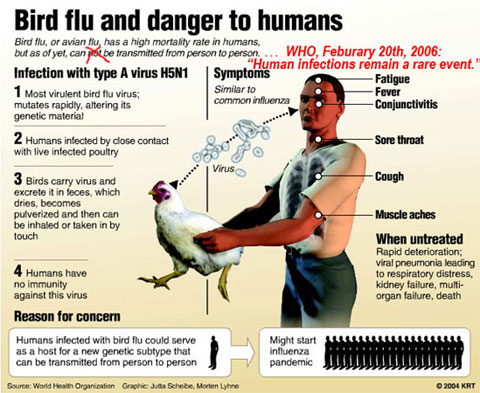
Multiple strains of flu virus from birds can be transmitted to humans. Infection from most forms leads only to mild symptoms in humans, but illness from the H5N1 strain can be deadly.
Outbreaks of H5N1 infection in birds have been rare. Those that began in Southeast Asia in 2003 were the most widespread and severe, according to the World Health Organization, which monitors cases of avian flu.
Nine Asian countries, including Japan, have reported previous H5N1 outbreaks. In Japan, the outbreaks were considered controlled and the country was considered free of disease, according to WHO.
While the bird flu scare has receded, the strain has never fully disappeared since the big outbreak seven years ago. Globally, some 40 human cases, including 20 deaths, have been confirmed by WHO this year. In 2009, there were 73 confirmed cases and 32 deaths.
On Nov. 17, a case of human infection was confirmed in Hong Kong, its first in seven years. In October, two human cases were reported in Indonesia.
It is “not unusual to see sporadic human cases” in regions where there are occasional outbreaks in poultry, said Aphaluck Bhatiasevi, a WHO spokeswoman, about the recent cases. Outbreaks can occur any time of the year, she said.
Japan was hit with the H5N1 strain of avian flu in 2004 for the first time in 79 years, and then again in 2007. Officials slaughtered 410,000 chickens and 170,000 chickens after each incident in western Japan. (Less virulent avian flu variations were detected in Japan in 2005 and 2009.)
In a sign officials think they have contained the spread this time, this week’s ban on egg shipments was lifted Friday as the flu tests on the birds in the nearby farms were negative. Restrictions on transporting poultry will remain until the safety of the area is confirmed by further testing on all the birds in the nearby farms for three weeks after the disinfection process is complete.
The agriculture ministry said in a statement that avian flu is a disease affecting birds and that even if humans consume infected meat and eggs, they would not be affected.
How the Shimane birds were infected is still under investigation, but it’s possible an infected wild bird entered the poultry house through some enlarged holes in the bird prevention net, said Ryuji Kawakami, a Shimane prefecture official.
“It’s really regrettable that this happens here, given that we make a routine check up on the sanitation of chicken houses diligently every month. This is one of the diseases that chicken farmers are most afraid of,” said Mr. Kawakami.
Dow Jones Newswires
Incoming search terms:
- chickens sign of bird flu