


 RSS Feed
 Email
 Twitter
 Facebook
Framework for warehousing receipt system in Pakistan
 Twitter
 Facebook
 Delicious
 Digg
 Stumble
 Reddit
THE current slow growth of the agricultural economy can partially be explained by virtual financial exclusion of small growers and unfair pricing of farm produce.
And one of the structural flaws in the sector is the lack of proper storage facility for crops. This not only compromises adequate availability of food items but also makes a reliable price discovery system difficult for domestic and export markets.
To help resolve these problems, the State Bank of Pakistan has developed a comprehensive framework for a commercially viable warehouse receipt system.
The proposed system “will allow farmers to have a reliable storage facility and the receipts against stored commodities could be used as collateral for bank financing,” says the SBP annual report for FY12.
Under the policy guidelines of the central bank and with the technical help of the USAID, Pakistan Mercantile Exchange has completed the design of an Electronic Warehouse Receipt Issuance Company which will manage a national network of warehouses for agricultural commodities.
“The concept is that these warehouses will be used for physical storage of commodities besides providing testing and certification services,” explained an official of SBP familiar with the project.
“The operators of these warehouses would be issuing electronic receipts against physically stored commodities that would be eligible to be used as collateral against bank financing.”
PMEX officials say the project is almost complete and would start facilitating the farming community shortly adding that the Punjab Agriculture Department has shown a keen interest in it.
With varying degree of intensity all provincial agriculture and food departments suffer from the lack of proper storage facilities.
Federally-run Pakistan Agriculture Storage and Supply Corporation also often runs short of storage facilities. Same is the case with Pakistan Trading Corporation. Stories about wheat or sugar stocks of these organisations lying in the open space continue to make newspaper headlines.
And as a matter of routine one also hears that foreign buyers have refused to buy our grains only because improper storage had affected their quality. Our poor agricultural storage system gets completely exposed when there is a natural disaster like heavy rains or floods. The post-disaster damages in terms of commodity losses translate into billions of rupees.“The answer to such predicaments lies in revolutionising our old ways of food crops storage with active involvement of the corporate sector,” says an official of Engro Food, one of the companies capable of operating large networks of physical storage of food commodities.
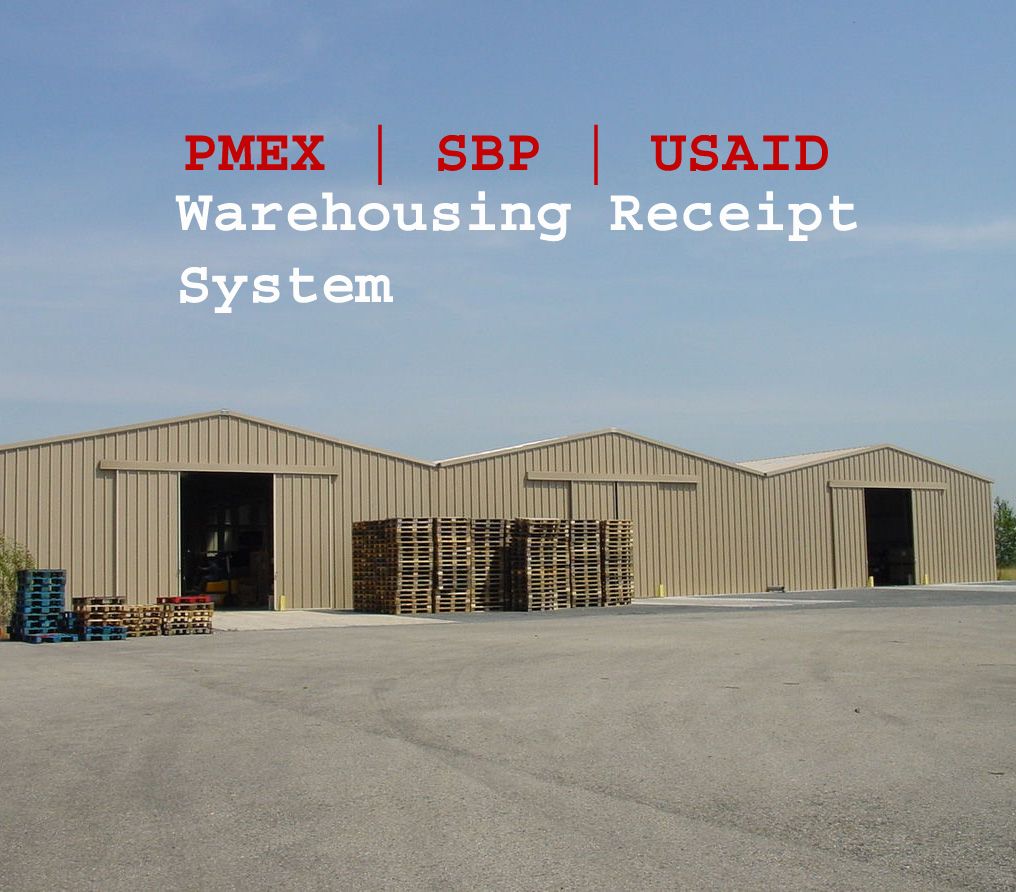
Such storage networks can serve the proposed Electronic Warehouse Receipt Issuance Company as the stocks of commodities physically available there could form the basis for the company to issue electronic receipts confirming available stocks of a certain commodity.
And later on, such a receipt would become entitled to serving as collateral for a bank loan requested by the holder of the receipt. However, physically available stocks of commodities with the provincial agricultural and food departments, PASSCO, TCP and commercially-run storage networks would also qualify to form the basis of issuance of electronic warehouse receipt.
“So, it would be a huge facility. Any individual or institution holding duly verifiable physical stocks of commodities would enter a large data bank from where information about the stored commodities would be retrieved to issue in favour of that individual or institution a receipt confirming the nature of the ownership of the stocks of commodities,” explained a senior executive of a bank familiar with the project.
Lack of proper collateral is a key impediment to credit disbursement by banks to small growers. Availability of verifiable stocks of agricultural commodities are considered the best kind of collateral in agricultural loaning but in the absence of a comprehensive data bank to verify the stocks of commodities and track their movements makes banks shy of accepting such stocks, particularly owned by small farmers, as anacceptable form of collateral.
The result is that banks’ per-person loaning to small farmers is humiliatingly low. In the last fiscal year banks disbursed Rs109.531 billion worth of farm loans for crop-raising to 1,347,269 small growers (i.e., those who own up to 12.5 acres of land).
This means each one of them got a tiny average loan of Rs8,130. Banks also distributed about Rs31 billion worth of non-farm loans (or loans meant for other agricultural activity) to 284,245 small growers. In this case too each one of these growers got an average loan of Rs10, 906 only. These stats are a sad commentary on the state of agricultural lending.
An SBP report on rural financing points out that the country’s overall agricultural-credit outreach is also very limited adding that less than one third of all farmers in Pakistan (two million against 6.6 million) have access to bank credit. The report says that 84 per cent of the total 6.6 million growers can be categorised as small growers and reveals that these growers mostly rely on informal sources of financing at exorbitant rates.
“One of the main reasons of the financial exclusion of these small farmers has been their inability to provide collateral to banks,” declares the report before outlining the features of a group-based financing scheme for such farmers.
Under this scheme banks have been encouraged to make both farm loans for raising crops and non-farm loans for other agricultural activity to groups of 5-15 small farmers who in their individual capacity cannot offer collateral. Each member assures the lending institution that he will remain a member of the group until his personal and of the group’s overall financial liabilities are cleared. And this commitment is treated as a sort of social collateral.
“If you piece together our initiative for Electronic Warehouse Receipt Issuance project and small farmers’ group financing, inclusion of microfinance banks into agricultural lending together with commercial banks, development of guidelines for agricultural financing by Islamic banks, you get a full picture of what is happening on agricultural financing front,” remarked a central banker.
“Central to all such efforts is the realisation of the fact that lack of formal financing to farmers, particularly small farmers, keeps us from exploiting full potentials of agricultural growth. The commodities sector is playing a very important role in the post-recession period — more important than many of us would have thought. And feeding a fast- growing population like ours with domestic resources is a really wise thing to do not only to keep our external sector balance in shape but also to minimise all other risks (associated with being a food deficient nation).”
— Mohiuddin Aazim
DAWN