


 RSS Feed
 Email
 Twitter
 Facebook
Commodity Round Up November 2011
 Twitter
 Facebook
 Delicious
 Digg
 Stumble
 Reddit
By Muhammad Irfan Kasana
In the month of October, 2011 a mix trend has been observed in commodity markets. Further commodities bounced back later this month.
The Standard & Poor’s GSCI Index of 24 raw materials has jumped 10 percent in October, on track for the biggest gain since May 2009. 19 of 24 commodities tracked by the GSCI rose last week, led by a 15 percent surge in copper that was the biggest gain since 1988.
Metals: After making all time high of US $ 1,900 / toz in September gold has slumped by almost 3.70 % in October. Silver market bounced back by almost 13 % in October after shattering the biggest drop of 30% in September.
Energy: Oil is up 20.81 % in October, the biggest monthly increase since May 2009.
SUGAR
Pakistan: Pakistan Sugar Mills Association Chairman Javed Kayani has appreciated the decision taken by ministry of industries to direct Trading Corporation of Pakistan (TCP) for the purchase of 200,000 tons of sugar at the prevailing market prices. The industry would be able to start crushing season on time without waiting to exhaust the existing stocks and clean up outstanding loans from commercial banks to avail finances for the purchases of sugarcane for the next crushing season.
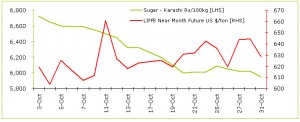
Prices remained on the downside for the second straight month where prices slashed by 11.52 % in October. Sugar opened at Rs 6,725 /100kg and closed at Rs. 5,950 /100kg on last trading day of month.
Global: A mix trend has been witnessed in international prices. So for near month sugar futures prices jumped up by 1.41% later part of the month, 2011 on LIFFE. Further more year to date prices plunged by 22%.
COTTON
Pakistan: PCGA leaders rejected the cotton production estimate of the Cotton Crop Assessment Committee (CCAC) describing it unfair and exaggerated and said that cotton production for 2011-12 would not be less than 15 million bales, and the government should ask the Trading Corporation of Pakistan to purchase the surplus produce of 3.4 million bales or at lest 2.5 million bales.
Prices dropped by 10.70 % in the month of October where as year to date slides downward by 37.5 %. Prices open at Rs. 6,400 / mound on first day of trading and closed at Rs. 5,750 /mound on last day
Further, several Pakistan textile products manufacturing units in the country were thinking to move their units to Bangladesh. Bangladesh has been offering a lot of incentives, including uninterrupted power supply and tax-free status for the first ten years and tariff-free access to markets in the European Union. The Pakistani businessmen already invested heavily in Bangladesh owing to these facilities.
Global: An overall higher trend has been witnessed especially later part of the month. China has said that it has started to buy cotton to rebuild state reserves. Demand remains soft on the export side. India has had a lot of Cotton to offer, but recent floods make it hard for Pakistan to talk of exports and easy for mills there to talk of new imports from India down the road. Prices jumped up by almost 4.64 % first time in last 6 month in October, where as year to date it slides by 31%.
Global 2011/12 production is forecast at a record 124.2 million bales, an 8-percent increase from the preceding year. China and India, the world’s largest and second largest cotton producers, are forecast to grow 33.5 million bales and 27.5 million bales, up 10 percent and 8 percent, respectively, from the previous year. Pakistan and the United States are forecast to produce 10.0 million bales and 16.6 million bales in 2011/12, a 14-percent increase from Pakistan’s previous crop and an 8-percent decrease in the United States.
World cotton exports in 2011/12 are forecast at 36.5 million bales, a 3-percent increase from the previous year. The United States, the world’s leading cotton exporter, is expected to export 11.5 million bales in 2011/12, down 20 percent from the previous year.
World’s largest cotton importer, China’s 2011/12 imports are forecast at 14.0 million bales, up 17 percent from a year earlier and the second highest on record.
World 2011/12 mill use is forecast at 114.3 million bales in 2011/12, virtually unchanged from the previous year.
Global 2011/12 ending stocks are forecast at nearly 55.0 million bales, up 22 percent from a year ago.
RICE [IRRI-6]:
Pakistan is likely to export 6.5 million tons rice during the current fiscal year 2011-12 as it is expected to have 10 million tons of crop production despite recent floods in lower Sindh.
In domestic markets a steep declined has been witnessed for rice: IRRI-6 prices, it might be due to the pressure of new crop. Prices remained in between Rs. 3,525 & 3,600 /100 kg. A 14.58 % decline over the month so for
Production Consumption / Trade Ending Stocks [August]
World 2011/12 production is forecast at a record 461.0 million tons, down 0.4 million from last month due mainly to decreases for Burma, Cambodia, Laos, and Thailand, which are partially offset by an increase for China.
The increase in global consumption is due mostly to an increase for China. Global exports are lowered slightly due to reductions for Burma and Cambodia, which are partially offset by increases for Argentina and Brazil. Global ending stocks for 2011/12 are projected at 100.6 million tons, down 0.8 million from last month, but an increase of 2.6 million from the previous year.
WHEAT:
he University of Agriculture Faisalabad scientists have introduced a software that gives experts’ opinion about use and balanced quantity of fertiliser and other information for wheat crop for the farming community.
By putting data of one’s land, area and location, one can easily get the expert’s opinion by the software.
It was revealed at a seminar on “Site specific fertiliser recommendations for wheat in Multan through website” arranged by the Endowment Fund Secretariat UAF.
Wheat remained in between Rs. 1,975 & 2,250 / 100 kg. A 10 % increased in prices has been witnessed in the month of September.
Production Consumption / Trade Ending Stocks [August]
Global wheat supplies for 2011/12 are projected 2.6 million tons higher mostly reflecting higher production in Kazakhstan and EU-27. Kazakhstan production is raised 2.0 million tons as an extended harvest period capped off a nearly ideal growing season, confirmed by the latest government reports. EU-27 production is raised 1.2 million tons with further upward revisions for France and Spain and higher reported production in the United Kingdom and Czech Republic.
World wheat trade is raised for 2011/12 with higher expected imports for China, a number of African countries, including Morocco and Algeria, as well as for Brazil and several FSU-12 countries neighboring Kazakhstan. Exports are raised 1.0 million tons each for EU-27 and Russia reflecting larger supplies in EU-27 and the continued heavy pace of shipments from Russia.
Global wheat consumption for 2011/12 is raised 2.4 million tons with increased feeding expected for Kazakhstan, Brazil, and Serbia. Larger crops in Kazakhstan and Serbia support more wheat feeding. Recent rains in southern Brazil have reduced wheat quality in some areas raising the potential for more feeding. Higher consumption is also expected for EU-27, Ethiopia, Kenya, and several smaller FSU-12 countries. Global ending stocks are projected 0.2 million tons higher.
Rising stocks in Kazakhstan, China, and Morocco are partly offset by reductions in major exporting countries including Russia, Argentina, and EU-27.
MAIZE:
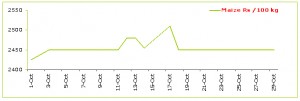
Maize prices remained quite stable over the curse of October. A 1.00 % change in prices has been observed so far. Prices remained in a narrow band of 2,425 Rs /100 kg to 2,510 Rs/100 kg.
Production / Consumption / Trade
World coarse grain production in 2011/12 is projected at 1,131.2 million tons, down 5.1 million this month. U.S. corn production in 2011/12 is forecast at 12.5 billion bushels, down 417 million from last month and only 50 million bushels above 2010/11, despite a 4.6-percent increase in planted area. World corn trade forecast for 2010/11 was adjusted down 0.3 million tons to 91.7 million tons.
Global coarse grain supplies for 2011/12 are projected slightly lower with reduced U.S. corn production. Corn production is lowered for a number of countries with the biggest reduction for Mexico where production is lowered 3.5 million tons.
World coarse grain trade for 2011/12 is raised with increased global imports and exports of barley and corn. Barley imports are raised for Algeria, Saudi Arabia, and Jordan with exports increased for EU-27 and Russia. Global corn consumption is mostly unchanged with higher industrial use and feeding in China and higher corn feeding in EU-27 and South Korea offsetting reductions in Mexico and the United States.
PALEMOLEIN:
Prices surged in the month of September by 3.14 % in both domestic & International markets where as 2.87 % in International markets so far. A very strong correlation exists in domestic & International markets. Domestic prices are collected from Jodia bazaar Karachi.
GOLD
After seeing all time highs in September Gold rallied below to 1,650 US$ / t oz in the month of October. Gold recovers in the later part of month where an over all 3.69 % rise observed.
Gold Prices fluctuated between $ 1621 – 1,743 per ounce in the whole month of October, 2011.
SILVER
An upward trend has been observed in the price of silver over the curse of October. A 12.95 % rise in the price.
Max price was $ 35.28 per troy ounce an ounce on 28th of October and min price was $ 30.09 troy ounce on 4th of October.
CRUDE OIL
Oil fell in New York on speculation demand on Monday (31st of October, 2011) will falter after the biggest monthly gain in more than two years and a surge in the dollar. Oil is up 20.81 % in October, the biggest monthly increase since May 2009.
Prices remained in between 76.56 & 93.83 US $ per barrel.
EXCHANGE RATE
After seeing the highest ever figure of 90 / US$ during the month of September rupee get stronger in the month of October by 2.34 % against US $. Exchange rate opened at 88.49 on first day of month and was at 86.42 on last trading day of October.
To contact with author please email at [email protected]
Copyright Agriculture Corner
1:14 am
Pakistan and the United States are forecast to produce 10.0 million bales and 16.6 million bales in 2011/12, a 14-percent increase from Pakistan’s previous crop and an 8-percent decrease in the United States. World consumption determines US commodity economic growth, prices and production. As an investor in commodities, it can all be a bit confusing. A prosperous cottton production can really make your increase your financial portfolio, but it is still important to do your research before getting started. .Agriculture.com is a great first step. Though I do work for them, the reason I use them myself is they honestly have all of the useful information I need. I really find the marketing strategies, expert commentaries, marketing and farming forecasts, and other useful data, you can download from their site to be helpful. I highly recommend them.