RSS Feed
 Email
 Twitter
 Facebook
A farm is greater than the sum of its parts
 Twitter
 Facebook
 Delicious
 Digg
 Stumble
 Reddit
 How a whole-farm approach to reducing emissions can create additional benefits for smallholder farmers
New off the press, the IPCC Fifth Assessment Report’s section on mitigation highlights the value of an integrated approach to agriculture, forestry and other land use. There are many interactions and feedbacks among homes, fields, forests, wetlands, pastures and livestock in human-managed landscapes. Thus we can make much more sensible decisions about mitigating greenhouse gas emissions if we understand the system as a whole, rather than accounting separately for each component.
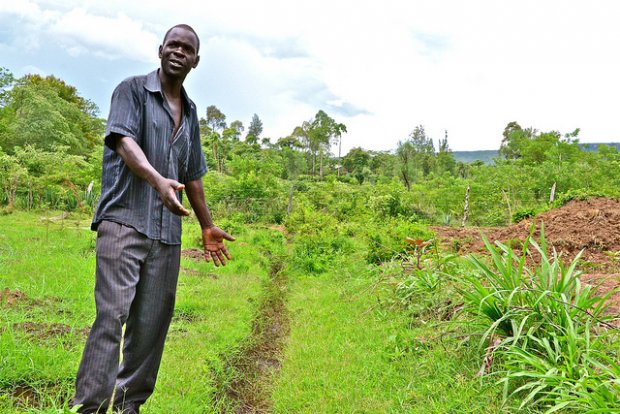
Whole farm quantification of GHG emissions within smallholder farms in developing countries, a recent article by Matthias Seebauer, shows how an integrated approach matters to mixed crop and livestock farms in Western Kenya. Under a project led by Vi Agroforestry, farmers have adopted various sustainable agricultural land management (SALM) practices – primarily to improve livelihoods, but there may also be co-benefits for mitigation. Relevant practices include managing crop residues and manure, composting, maintaining cover crops, and agroforestry.
Seebauer uses two well-established tools to estimate farm-wide emissions: the VCS SALM methodology and the Cool Farm Tool. These tools both calculate emissions per hectare for interlinked farm activities, but they classify activities differently. Indeed, a persistent challenge for tools like these is accurate inclusion of the highly varied practices of smallholder farmers, particularly across whole landscapes that include grazing and forest areas as well as fields and penned livestock.
Comparing farm emissions in 2009 and 2011, before and after the adoption of sustainable land management practices, helps to identify which options work best for farmers’ livelihoods and food security, as well as mitigation. Overall, adoption of SALM has had a significant impact on annual mitigation benefits, ranging between 4 and 6.5 tonnes CO2 equivalent per hectare. There are several win-wins. For instance SALM benefits crop yields and provides by-products like animal feed, while also removing atmospheric carbon into soils and woody biomass. However, not all new practices benefit mitigation. Farmers participating in the SALM project have discontinued use of artificial nitrogen fertilizers, but the emissions calculations show that the low levels of fertilizer use in 2009 produced minimal emissions anyway.
Other dynamics are more complex. By far the highest emissions, up to 7 tonnes CO2 equivalent per hectare, come from livestock, via enteric fermentation and manure management. Decreases between 2009 and 2011 are largely linked to declining numbers of animals, particularly cattle. The analysis shows there are ways to reduce emissions that bring income benefits to farmers without reducing animal numbers, such as improving feed quality with legumes, which are planted within grazing lands or as hedgerows or intercrops in fields.
Seebauer’s article is just one among a set of valuable policy-relevant articles in a special issue of Environmental Research Letters on mitigation in the agriculture and land use sectors in developing countries. In parallel, scientists in the program SAMPLES are working across three continents to develop more comparable, accurate and affordable measurements of emissions and mitigation options. Collaborative science, like farming, can be more than the sum of its parts.
http://ccafs.cgiar.org
Related articles