


 RSS Feed
 Email
 Twitter
 Facebook
Mobile apps drive farming’s future
 Twitter
 Facebook
 Delicious
 Digg
 Stumble
 Reddit
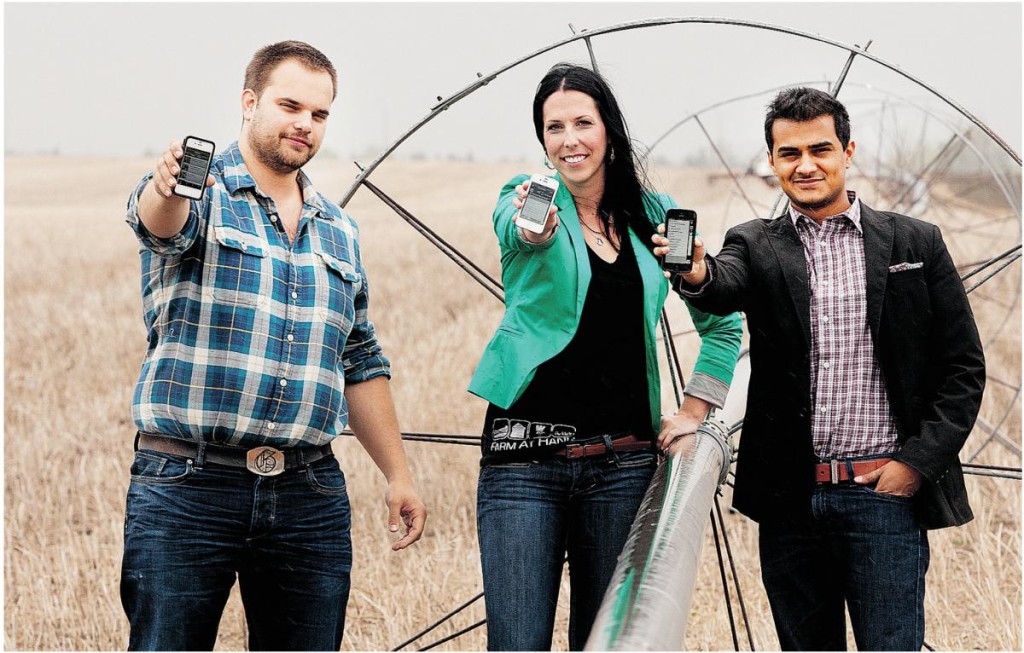 Kim Keller was driving a grain cart through her fields near Melfort one day last year when she decided she’d had enough of the clunky, desktop-bound software she was using to manage her farming business.
Three months later, the 29-year-old and her business partner Himanshu Singh launched a homegrown mobile app called Farm at Hand. It allows farmers to track field data, sales and deliveries from anywhere, and it has grown like a bumper crop.
“Our focus is in North America, but we do have users in the U.K., Australia, Brazil and South Africa,” she said. “We’re sitting at about 8,500 registered accounts right now.”
Keller is on the forefront of a booming business of bringing mobile app technology to the farm. The trend is gaining momentum and farming apps developed by local startup companies took second and third place at this year’s i3 Idea Challenge, run by the Brett Wilson Centre for Entrepreneurship.
Stephanie Yong, the centre’s director, said the wave of tech-savvy farm kids inventing apps is just beginning.
“There is such a large opportunity and a large market,” she said. “I think we’re going to see these really come out of the woodwork and explode over the next year.”
Bradley Weiers has always loved the farmer’s life, having grown up on the family farm outside Meadow Lake.
But with the family farm being turned over to a sibling, 25-year-old Weiers pursued engineering and computer science at the University of Saskatchewan and began the hunt for an alternative livelihood.
“I had to figure out something else to do because I have an older brother who is going to take over the farm,” he said.
Weiers, along with fellow student and business partner Lindsay Sweet, are behind CropSprouter. This mobile app zeros in on a problem farmers have struggled with forever: identifying weeds when they are still immature, using a library of photos and questions that quickly narrow down the search to one of 60 common weeds that grow on the Canadian Prairies.
Contrary to the stereotypes of those who raise and harvest crops as bumpkins, Weiers said farmers have always been early adopters of technology. Whether it’s new seeds, machines or herbicides, he said, farmers generally have no sentimental attachment to old ways of doing things, according to Weiers.
“You could have the most old-school, ancient farmer who was around when they were still using threshing machines,” he said. “But if it’s newer, faster or better, he’ll always take it.”
While the app was still in its initial stages, Weiers said his father and his friends were bugging him for an early version to take to the fields immediately.
The average Saskatchewan farmer spends $40,000 each year on herbicides, Weiers said, and about $880 million is spent on weed control in the province annually. With so much money riding on getting the right chemicals on the ground, farmers will do whatever they can to make the right decision.
“If a farmer identifies the wrong weed and applies wrong chemical, then it could be all wasted,” he said.
© Copyright (c) The StarPhoenix